An AI game prototype scoring system test compares a few scoring rules inside the same tiny playable scene before you build more levels. Make three variants, survival time, combo multiplier, and risk-reward bonus, then pick the one that changes player behavior in the direction your game needs.
Scoring looks like polish until it changes what the player tries next. A survival timer makes players avoid danger. A combo multiplier makes them chain actions. A risk bonus makes them flirt with failure on purpose. Same room, same controls, different game.
That is why you should test scoring before content. If the prototype already has one room, one enemy, and one reset button, you have enough material to learn something. More levels will mostly hide the signal.
This is a practical workflow article for builders using AI-assisted prototyping with engines and no-code tools. The citations point to official documentation for custom events, signals, and event-based game logic because the article focuses on observable player actions, not analytics dashboards as a product category.
Unity
Useful when you want custom events, structured playtest logging, and a later path into a larger production pipeline.
Godot
Useful when you want scoring logic wired through signals and small scenes that are easy to duplicate for variants.
GDevelop
Useful when you want visible event logic for score changes, collisions, timers, and simple prototype rules.
Do Not Ask Whether the Score Is Fun
That question is too mushy for a first playable. Ask what the score makes the player do. Do they wait? Rush? Take risks? Repeat the same move? Ignore the enemy? Once you know that, you can decide whether the scoring rule supports the game you meant to build.
AI is useful here because it can generate small rule variants faster than you can debate them. The trick is to keep the environment fixed. Do not change enemy speed, player movement, room size, art, or spawn timing while you change the score.
A scoring system is a steering wheel. Test where it points before you pave more road.
Three Scoring Variants Worth Testing
| Variant | Player behavior it rewards | Bad sign |
|---|---|---|
| Survival timer | Staying alive, reading patterns, managing space | Players stall in the safest corner |
| Combo multiplier | Chaining actions, staying active, recovering after mistakes | Players spam one safe action because it farms points |
| Risk-reward bonus | Taking dangerous routes, engaging with hazards, choosing timing windows | Players ignore the bonus because the penalty is too harsh |
Use One Room and One Score Event Log
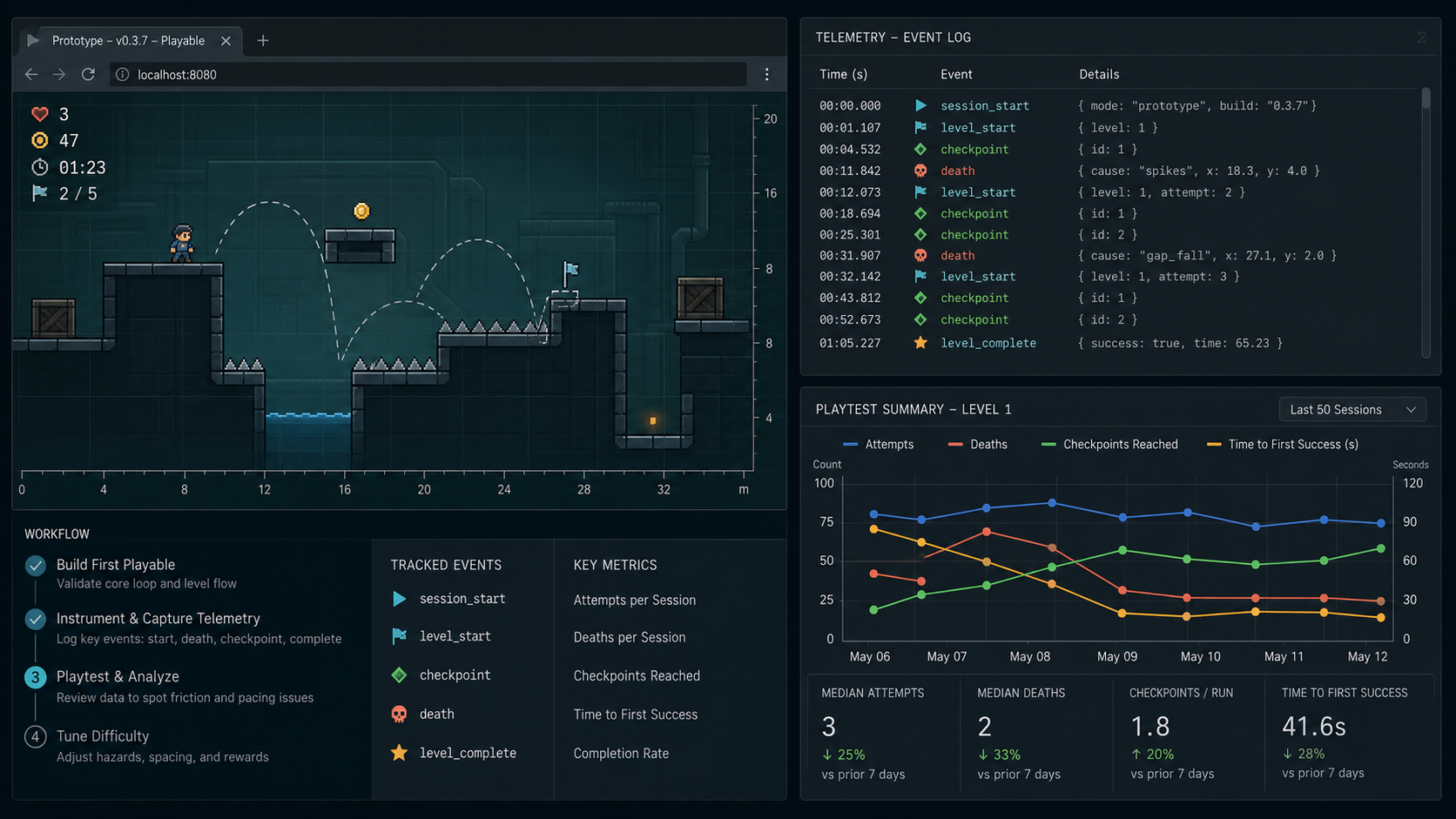
The test scene should be boring to look at and useful to read. Put the score where the player can see it. Then log a few events: run started, first point earned, first damage taken, first death, best score, and reset. You do not need a full telemetry stack for this. A console log, local debug panel, CSV export, or notebook beside the test machine is enough.
The point is not to collect a giant dataset. You are trying to catch obvious behavior shifts before the design hardens around the wrong incentive.
Weak Prompt vs Scoring Test Prompt
| Goal | Weak prompt | Better prompt |
|---|---|---|
| Add score | Add a scoring system to the game | Keep the same room and controls. Create a variant where the player earns 1 point per second alive and loses the run on contact. Add a visible timer and log run duration. |
| Test combos | Make scoring more exciting | Create a second variant where each pickup within 3 seconds increases a combo multiplier by 1. Reset the multiplier on damage. Do not change pickup placement. |
| Test risk | Reward brave players | Create a third variant with a risky bonus zone near the enemy path. Award 5 points per pickup there and 1 point elsewhere. Keep enemy speed unchanged. |
| Compare results | Tell me which version is best | After each run, show score, duration, damage count, and highest combo. Use the same output format for all three variants. |
What to Measure in Five Runs
Five runs will not prove balance. They can still expose a dead scoring rule. If every player survives by avoiding the core mechanic, the timer is probably rewarding passivity. If the combo rule makes one move dominant, the multiplier is doing the designer work badly. If nobody enters the bonus zone, the bonus is not tempting enough or the danger is too opaque.
Use a survival timer
You want tension, readable threats, and a clean score that anyone understands in one second.
Dodge games, arena survival, stealth tests, and prototypes where endurance is the point.Use a combo multiplier
You want the player to stay active and recover rhythm after small mistakes.
Arcade action, collection games, score attacks, and prototypes built around flow.Use a risk-reward bonus
You want players to make visible tradeoffs instead of optimizing one safe route.
Platformers, hazard rooms, extraction loops, and games where bravery should pay.How Engines Change the Test
Unity is the better fit if you already know you want custom event schemas, dashboards, and production analytics later. Godot is clean for signal-driven score updates because the score system can listen to pickups, damage, timers, and deaths without every object knowing about every other object. GDevelop is good when the team benefits from seeing conditions and actions directly in the editor.
Those tool differences matter less than the test discipline. A sloppy prompt in any tool will mix scoring changes with level changes and leave you guessing. A tight prompt isolates the rule.
- Use the same room for all scoring variants.
- Change one scoring rule at a time.
- Keep player speed, enemy speed, hazards, and pickups fixed.
- Log run duration, score, damage, death, and reset.
- Watch for behavior, not praise.
- Choose the rule that makes players interact with the core mechanic.
If a scoring rule does not change player behavior in a useful way, more levels will only give that weak incentive more places to fail.
FAQ
What is an AI game prototype scoring system test?
It is a small playtest where you ask AI to generate a few scoring variants inside the same prototype scene, then compare how each rule changes player behavior.
How many scoring systems should I test first?
Three is enough for a useful first pass: survival timer, combo multiplier, and risk-reward bonus. More variants usually slow the decision down.
Should I add analytics before the game is fun?
Add simple event logging, not a heavy analytics process. You need enough evidence to see what players do, then you can tune the scoring rule or throw it out.