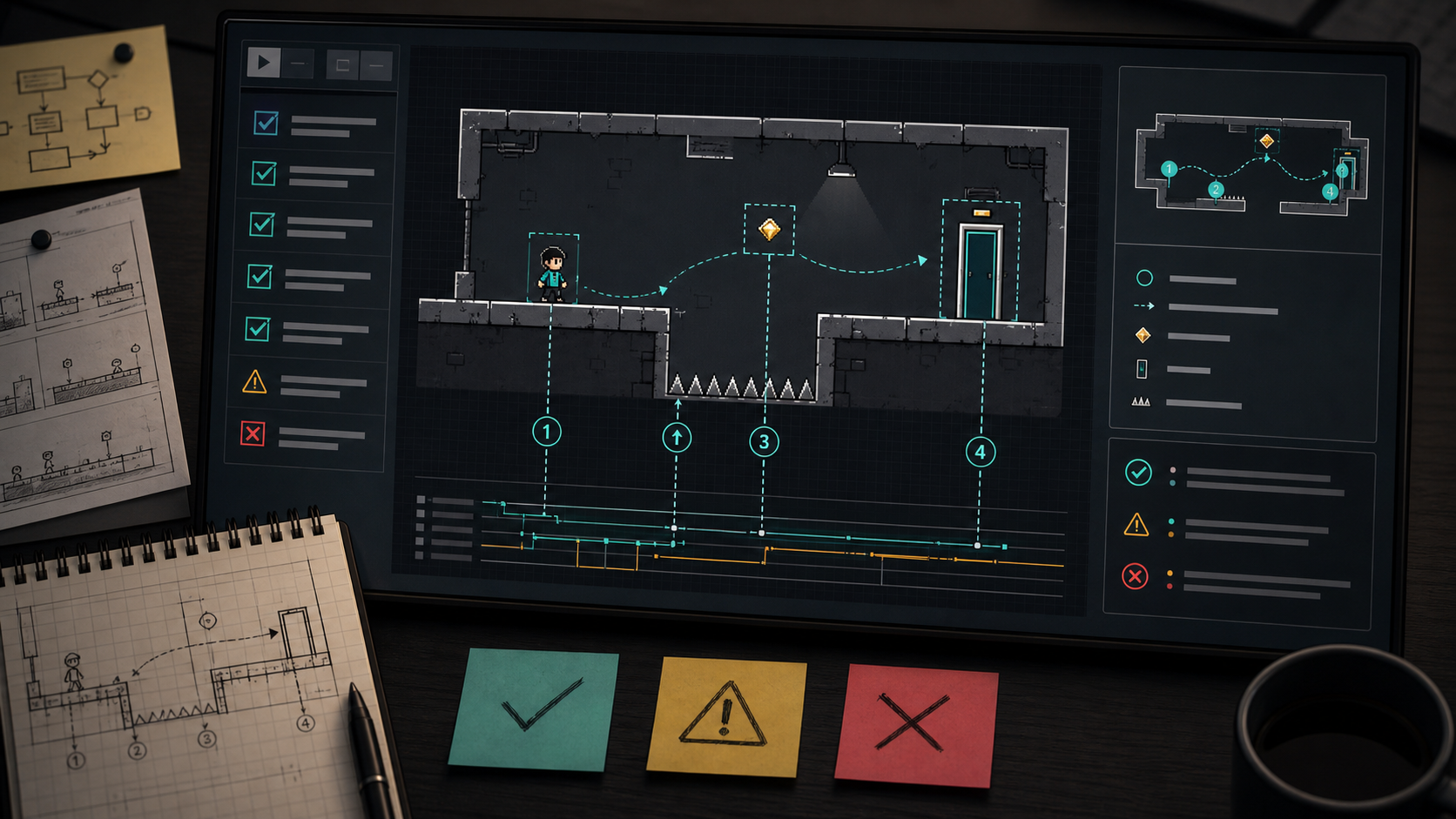
An AI game prototype tutorial room test checks whether a new player can learn one action, one risk, one reward, and one exit in about 30 seconds. Keep it to one screen, watch the first failed attempt, then add mechanics only after the room teaches the first verb without a paragraph of instructions.
AI can generate mechanics faster than players can understand them. That is useful when you are exploring. It is expensive when the first room asks the player to parse movement, jumping, attacking, pickups, health, doors, score, and camera behavior all at once.
The first tutorial room should be a test bench, not a museum of features. You are trying to learn whether the player can form a working sentence: I do this, avoid that, collect this, and reach there. If they cannot say that after one short attempt, more mechanics will not clarify the game.
This is a practical workflow article for AI-assisted 2D prototypes. The sources point to official input and event documentation because the article is about building a repeatable onboarding test, not a tool announcement.
Godot
A good fit for small 2D rooms where input events, collisions, and scene resets need to stay easy to inspect.
Phaser
Useful when the tutorial test should be browser-first and you want direct control over input, scenes, and restart loops.
GDevelop
Practical when you want visible event logic for prompts, pickups, doors, timers, and fail states.
Unity Input System
Worth using when the prototype is already headed toward a larger Unity project with explicit action bindings and interaction states.
The First Room Has One Job
A tutorial room is successful when the player learns by doing and reaches the exit with a reason to try again. It is not successful because it displays controls. It is not successful because the AI generated a clever enemy, three doors, and a shop menu.
For a first playable, strip the room down to four objects: the player, a safe practice space, one consequence, and one reward. If the core verb is jump, the room needs one jump problem. If the verb is dash, it needs one dash problem. If the verb is aim, it needs one target that proves whether aiming makes sense.
If the first room needs a lecture, the mechanic probably needs a smaller test.
The 30-Second Tutorial Gate
| Gate | What it tests | Bad sign |
|---|---|---|
| Movement gate | Can the player reach the first interaction without guessing controls? | They press random keys or stop before the first obstacle |
| Verb gate | Does one action solve one visible problem? | They use the verb accidentally and cannot repeat it |
| Consequence gate | Does the room show what failure means without feeling cheap? | They fail without seeing why |
| Reward gate | Does the pickup, door, score, or state change confirm progress? | They succeed but do not know what changed |
Prompt the Room as a Test, Not a Tutorial
The weak prompt asks for onboarding. The stronger prompt asks for an observable gate. You want the AI to hold the camera, room size, player speed, collision rules, and restart behavior steady while it teaches one thing.
Ask for visible debug state during early runs. A small overlay with time to first input, first failure, reward collected, and exit reached is enough. You do not need a full analytics stack. You need to know where the player hesitated.
Weak Prompt vs Tutorial Room Test Prompt
| Goal | Weak prompt | Better prompt |
|---|---|---|
| Teach movement | Add a tutorial to explain the controls | Create one screen where the player starts on the left and must move right to reach a door. Show no text except the current input prompt. |
| Teach the verb | Add a jump tutorial | Place one gap that cannot be crossed by walking. Keep player speed fixed. Let the player retry instantly after falling. |
| Teach risk | Add hazards to make it harder | Add one visible hazard after the safe practice jump. The hazard must be avoidable on the first attempt if the player understands the jump. |
| Log comprehension | Track whether the tutorial works | Record time to first move, first jump, first failure, reward pickup, and exit reached. Show those values after reset. |
Run It With Three Kinds of Players
You do not need a big panel. You need three useful reads. First, play it yourself and write down where your hand waits. Second, give it to someone who has not seen the prompt. Third, give it to someone who plays the genre and ask them where the room wastes time.
Do not explain the game before they play. The room is being tested, not your pitch. If they ask what to do, mark the timestamp and stay quiet. That question is data.
Simplify the layout
Players stop before the first obstacle or inspect irrelevant space.
Rooms with too many platforms, doors, props, enemies, or UI signals.Change the prompt timing
Players know the action but see the hint too early or too late.
Input prompts, ability reveals, pickup instructions, and door interactions.Lower the penalty
Players understand the verb but the first miss breaks the learning rhythm.
Jump gaps, dash timing, hazard lanes, and early combat rooms.Add the next mechanic
Players complete the room twice and can describe the verb, risk, reward, and exit.
The moment after comprehension is proven, not before.Engine Choice Comes After the Lesson Works
Godot is comfortable for this test because small scenes, input events, collisions, and quick resets stay readable. Phaser is strong when you want a browser-playable room and direct code control. GDevelop works when the team benefits from seeing event conditions in plain editor logic. Unity makes sense when the tutorial is already part of a bigger production input system.
The tool choice should not be the hard part yet. The hard part is protecting the test from extra features. If the AI changes the room, the player verb, the hazard, and the reward in the same revision, you will not know which change taught the player.
- Keep the first test to one screen and about 30 seconds.
- Teach one verb before adding a second mechanic.
- Use one visible risk and one visible reward.
- Let the player retry immediately after failure.
- Record first input, first verb use, first failure, reward pickup, and exit reached.
- Do not explain the room before the first external playtest.
Add mechanics after the first room teaches one action cleanly. A confused tutorial is not early-game content. It is a failed test.
FAQ
What is an AI game prototype tutorial room test?
It is a one-screen playable test that checks whether a new player can learn one action, face one risk, collect one reward, and reach one exit without a long explanation.
How long should the first tutorial room be?
Aim for about 30 seconds on a successful run. That is long enough to test comprehension and short enough that a failed attempt is cheap.
Should I add more mechanics before the tutorial feels good?
No. Add the next mechanic only after players can repeat the first action and explain what the room asked them to do.